Turn Technician Voice Notes into Service Bay Productivity
Use Wrench Voice to convert your technician's voice directly from their mobile into formatted Repair Orders documentation—ready for DMS portals, CCC entries, and faster insurance approvals.
Trusted by Car Dealerships and Autobody shops across the United States
Backed By
 Nvidia Inception
 Google Cloud for Startups
Nvidia Inception Program
The NVIDIA Inception Program is designed to help startups accelerate innovation and growth. Program members get access to the latest developer resources and training, exclusive pricing on NVIDIA hardware and software, and exposure to the venture capital community.


See WrenchVoice in Action
Beautiful interfaces designed specifically for automotive professionals.
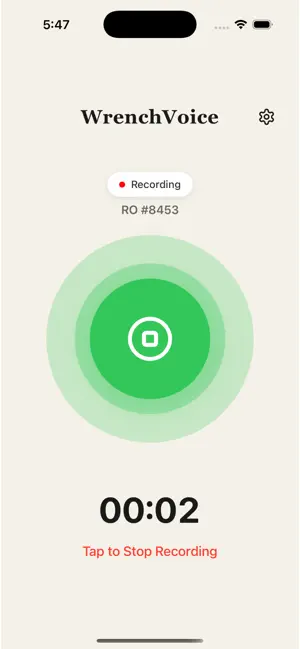
Mobile App Made for Techs
Just hit record and start talking. Our iOS and Android apps instantly sync your spoken notes directly to the website.
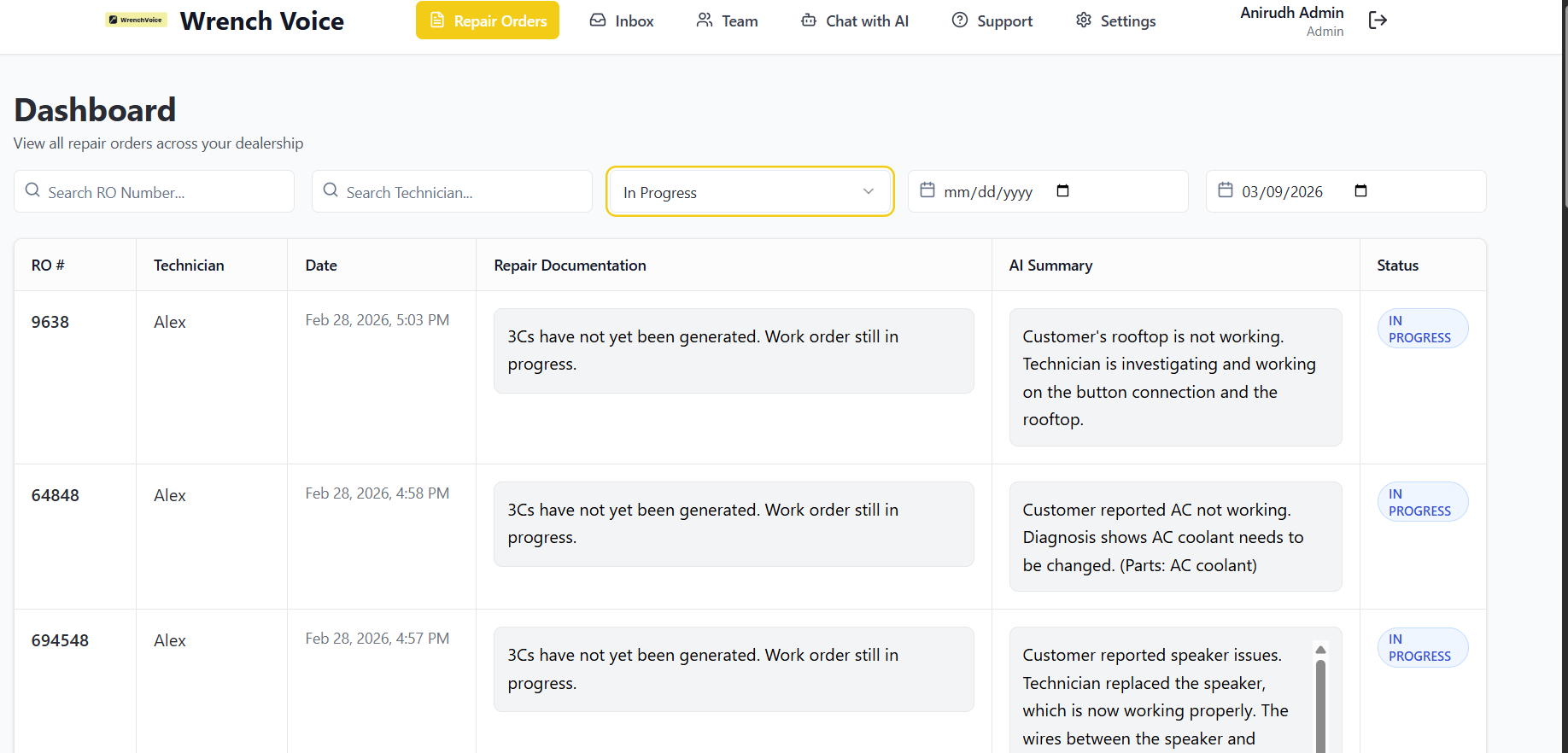
Main Dashboard
A unified view common for both collision shops and car dealerships to track all active repair orders at a glance.
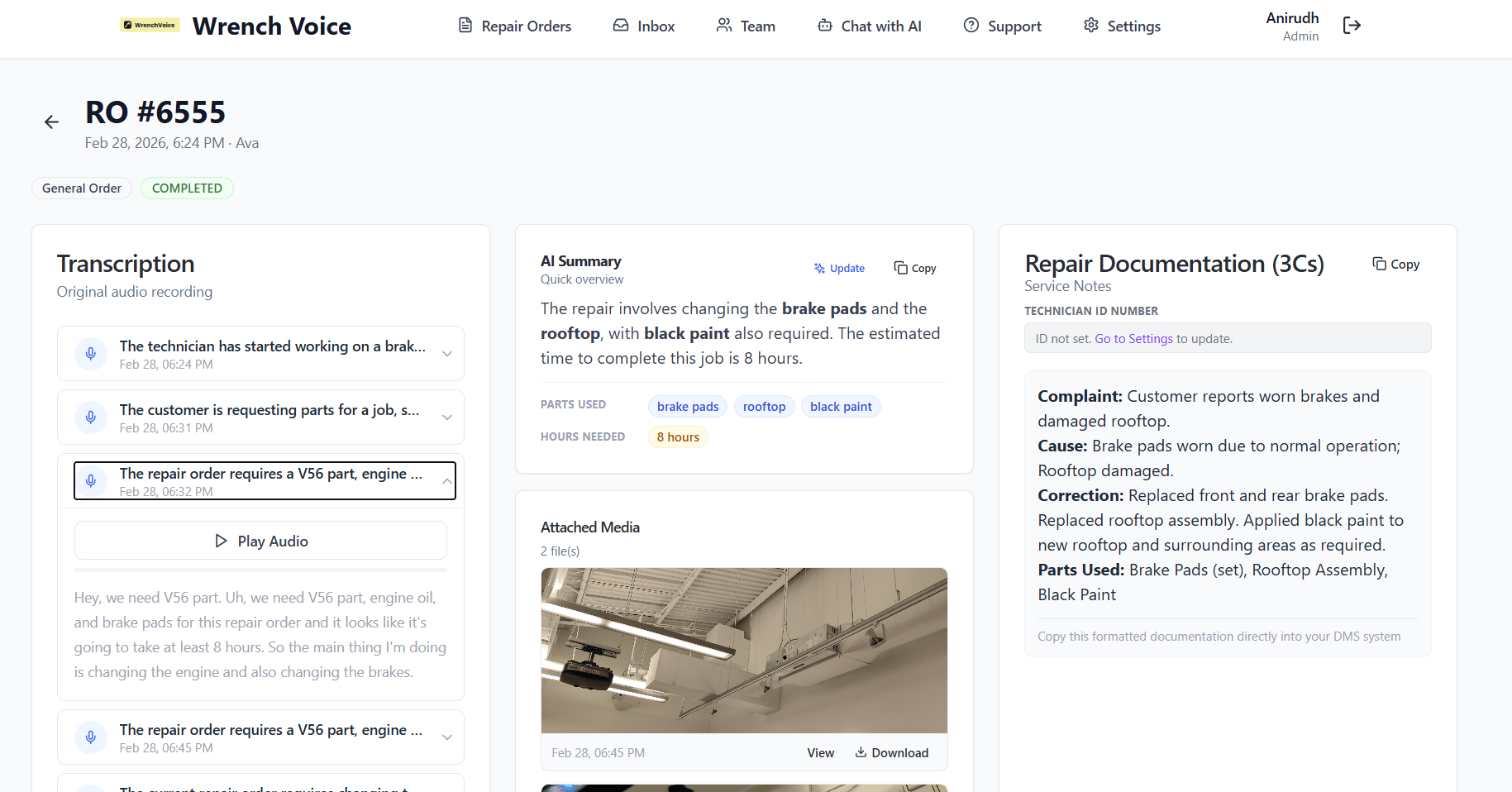
Autobody Dashboard
Everything insurance estimators need: AI summary, parts, and notes.
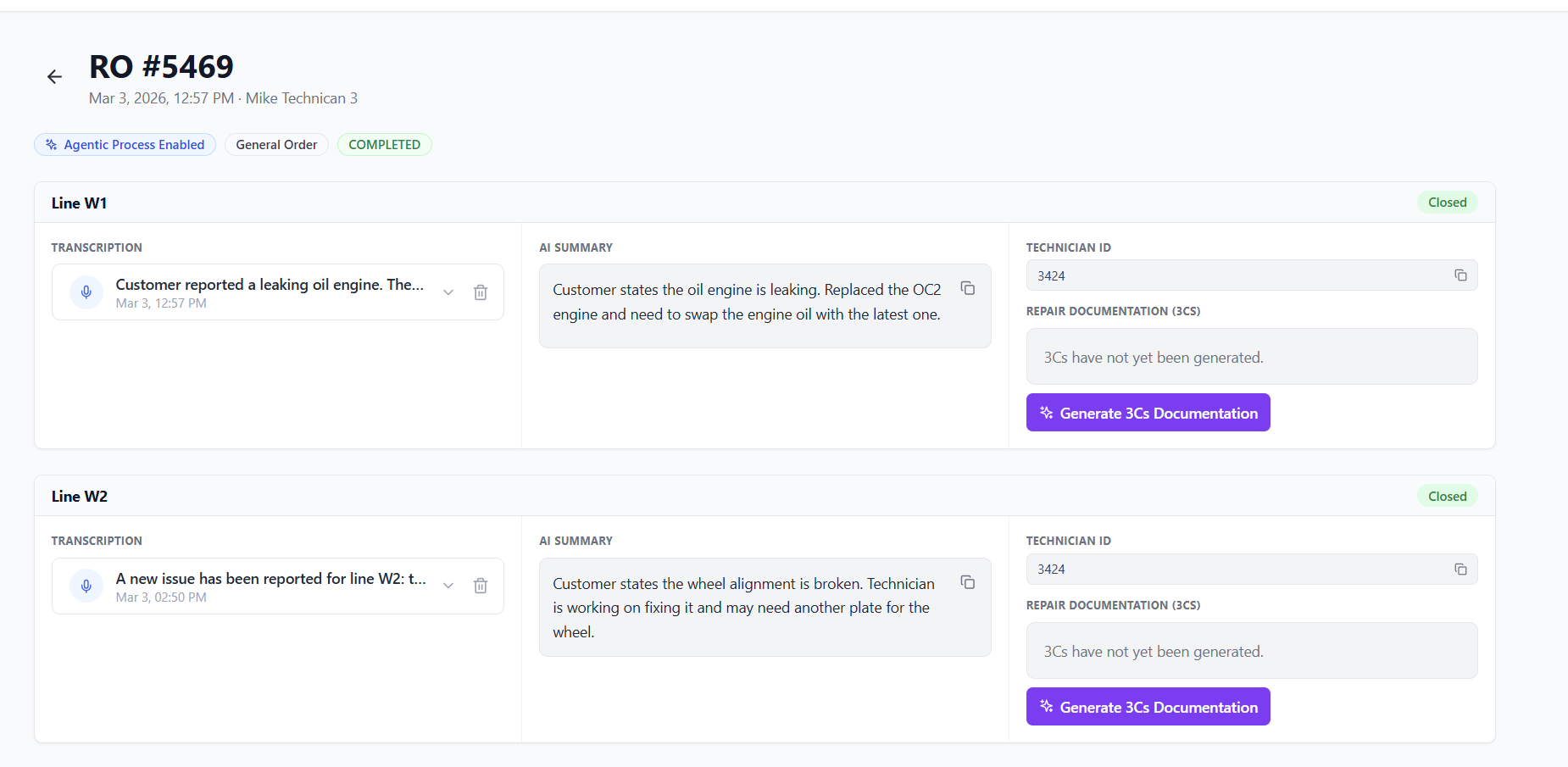
Car Dealerships ROs
Required by car dealerships for perfect line-wise summaries and 3Cs documentation.
Roll More Cars Out of The Bay
Roll more cars by saving time needed to carry insurance supplement sheets and the typing needed. We are selling time: start eliminating typing for technicians, allowing them to freely describe complicated diagnostics with repair order codes and part numbers,so they can focus on what they do best.
For Car Dealerships
Stop making your technicians type! Simply have them talk into our app, and our AI transcribes it into an AI Summary, including parts and hours needed, instantly.
Our AI understands the nuance and perfectly shows a line-wise summary and 3Cs documentation, ready for DMS copy-paste after the RO is complete.
For Repair & Collision Shops
Get rid of insurance supplement sheets. Insurance Estimators no longer have to chase technicians or walk down to the bay to get updates.
With WrenchVoice, estimators can see everything,from diagnostic notes to parts to AI summaries,in one centralized dashboard. Seamless handoffs mean faster approvals and less friction.
How disorganization and weak documentation hurt productivity
Here are some concrete ways lack of organization and documentation drags down output in auto body shops and dealerships:
Wasted technician and advisor time
When Repair Orders, photos, supplements, and OEM procedures are scattered across emails, paper, and multiple apps, techs spend minutes per job just finding the right information. Multiply even 5–10 extra minutes per RO by hundreds or thousands of ROs per month and you lose many billable hours of labor capacity.
Advisors re‑enter the same customer and vehicle data into different systems (DMS, estimating tool, CRM), which adds non‑billable admin time and slows check‑in and dispatch.
Longer cycle times and reduced throughput
Poorly tracked parts orders, supplements, and approvals cause vehicles to sit idle waiting for decisions or parts that no one realized were missing. That increases keys‑to‑keys time and clogs bays that could be turning more profitable work.
Without a live view of WIP and technician loading, jobs get dispatched unevenly, so some techs are buried while others are underutilized.
More rework and comebacks
If OEM repair procedures and calibration requirements aren't attached clearly to the RO, shops risk missing steps, which leads to comebacks, warranty re‑repairs, and insurer pushback. Industry sources note that not all shops consistently access OEM procedures because of cost and process friction, and this directly affects repair quality.
Weak photo/document trails make it harder to defend estimates to insurers, prompting re‑inspections and re‑writing estimates, which burns more time for no extra revenue.
How this hits revenue and profit
Disorganization doesn’t just make days more chaotic; it directly caps hours sold, upsell capture, and margin:
Lower hours sold per RO
One industry analysis comparing “manual” vs more automated, organized dealerships found that stores using better process and tooling sold 1.74 hours per RO versus 1.55 hours for manual operations—an extra 0.19 labor hours per transaction. That translated to about 26.60 dollars additional revenue per RO before parts markup.
On a shop doing thousands of ROs per year, a 0.1–0.2 hour gap per RO adds up to tens or hundreds of thousands of dollars of lost labor revenue.
Missed profit from inconsistent pricing and parts matrices
A 2024–2025 fixed‑ops benchmarking report showed that shops with broken or inconsistently used parts pricing matrices can leave roughly 40,000 to 70,000 dollars of profit on the table annually, simply because staff are not following a standardized process.
When advisors keep their own spreadsheets or “cheat sheets” instead of one shared system, margins vary by person and shift, and management can't see where profit is leaking.
Reduced customer retention and referral revenue
Disorganized communication (missed updates, unclear timelines, lost voicemails) erodes trust, which drives customers to independent shops or competitors even if the technical quality is good. Studies of service profitability emphasize that improving communication and documentation in the service lane boosts loyalty and referrals, which raises long‑term revenue per customer.
In collision, slow, opaque processes hurt relationships not just with customers but also with insurers and DRP partners, which can reduce referral volume.
Built for the Modern Repair Shop & Dealership
Everything you need to streamline your repair documentation process.
Voice-to-Claim AI
Automatically formatting and generating 3C's documentation that is ready for copy-pasting into CCC and DMS.
Unified RO Tracking
All RO details are tracked in one place. Technicians can attach photos, making it easy for support staff to explain charges at the desk or file accurate warranty claims.
Team Sync
Advisors and Insurace Estimators see RO details instantly. Parts department can search inventory and parts in seconds with AI chatbot.
Ask Our AI Assistant Anything
Our AI understands your repair orders. We never train on your data. The AI chatbot temporarily reads your ROs to answer your questions. Ask natural questions and get instant answers—no spreadsheets or digging through notes.
"What was the specific measurement of the brake pad inner vs. outer wear on the Silverado from this morning?"
"Summarize any 'struggle points' the tech mentioned during the engine tear-down on the Acadia."
"On the Jeep Grand Cherokee job, did the tech mention using any shop supplies or fluids that aren't listed on the parts invoice?"
"Did the tech confirm the 'Complaint' was duplicated during the test drive, and at what speed did it happen?"
Enterprise-Grade Security
Your data is encrypted, protected, and compliant.
End-to-End Encryption
Data at rest is secured using AES-256-GCM encryption. Data in transit is protected via TLS 1.3.
Secure Credential Hashing
Passwords and sensitive credentials are hashed using Argon2id, the winner of the Password Hashing Competition.
Payment Data Isolation
We do not store card details. All payment processing is tokenized and handled by a PCI-DSS Level 1 certified provider.